
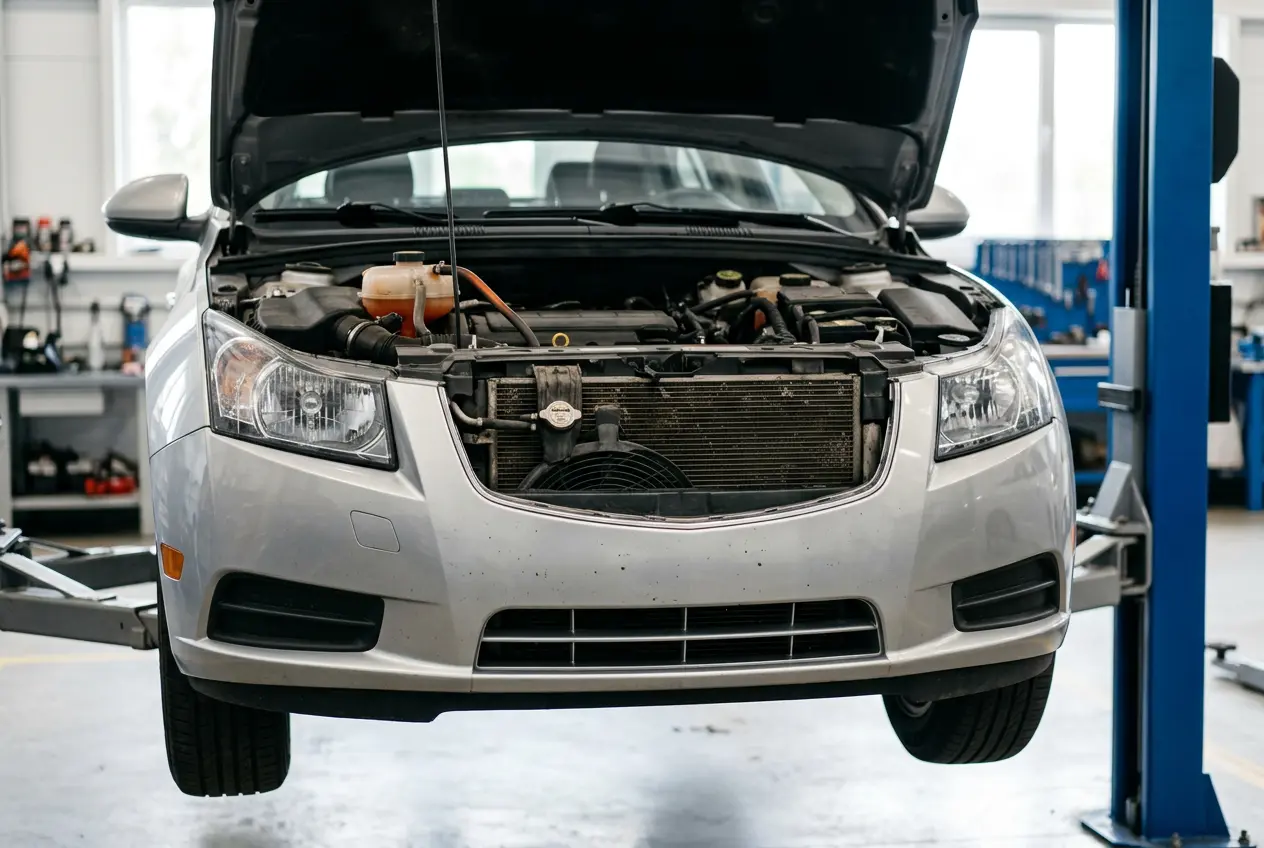
A coolant smell, a dropping coolant level, or a high-pitched whistle from your 2011-2019 Chevrolet Cruze with the 1.4L turbocharged engine is commonly diagnosed as one of two problems: a cracked or leaking coolant outlet housing near the thermostat, or a torn PCV diaphragm inside the valve cover. Both issues are well-known on this engine family. Neither fixes itself, and ignoring either one long enough will cause bigger, more expensive damage.
Which Cruze models does this affect?
This pattern is commonly reported on 2011-2019 Chevrolet Cruze models equipped with the 1.4L turbocharged four-cylinder engine (engine code LUJ or LUV depending on the model year). If your Cruze has the 1.8L naturally aspirated engine, these specific issues do not apply. The 1.4T was the volume engine in this generation, so the majority of Cruzes on the road today carry it.
What are the symptoms, and how do they get worse over time?
Early stage
- A faint sweet smell from the engine bay after driving, especially when the car sits after a warm run.
- Coolant reservoir level drops slowly between top-offs, with no visible puddle under the car.
- A faint hiss or whistle at idle that disappears at higher RPM.
Middle stage
- The coolant low warning light comes on periodically.
- The whistle becomes consistent and louder at idle or light throttle.
- Rough idle or a slight hesitation on acceleration appears, caused by unmetered air entering the intake through the torn PCV diaphragm.
- You may notice a small coolant stain on the front of the engine near the thermostat housing.
Late stage
- The temperature gauge climbs toward the red zone.
- White steam from under the hood.
- Coolant loss becomes rapid enough to require topping off every few days.
- Oil contamination from the PCV failure can foul the throttle body and intake passages over time.
What happens if you keep driving it?
Continued coolant loss leads to overheating. Overheating on the 1.4T Cruze risks warping the aluminum cylinder head, which turns a housing replacement into a head gasket or head replacement job. If the PCV diaphragm failure goes unaddressed, oil mist accumulates in the intake system and can cause carbon buildup on the intake valves over time. Stop driving if the temperature gauge enters the red zone or if you see steam from the hood.
What are the two most common root causes?
1. Cracked coolant outlet housing (thermostat housing)
The coolant outlet housing on the 1.4T is a plastic assembly that houses the thermostat and connects to the upper radiator hose. It is commonly diagnosed as the source of coolant loss on this engine. The plastic becomes brittle with age and heat cycling, and cracks typically form at the housing flange or around the sensor port. The leak is often internal at first, meaning coolant drips down the back of the engine rather than pooling visibly on the ground.
2. Torn PCV diaphragm in the valve cover
The 1.4T Cruze uses a valve cover with an integrated PCV (positive crankcase ventilation) system. Inside the cover is a rubber diaphragm that regulates crankcase pressure. This diaphragm is commonly diagnosed as the source of the vacuum whistle and rough idle on higher-mileage examples. When it tears, crankcase pressure escapes into the intake tract as an uncontrolled vacuum leak. The fix is replacing the entire valve cover assembly, because the diaphragm is not serviceable separately on most applications.
Symptom, likely cause, and urgency at a glance
| Symptom | Likely cause | Urgency |
|---|---|---|
| Sweet coolant smell, slow level drop | Coolant outlet housing crack | High, inspect within a week |
| High-pitched whistle at idle | Torn PCV diaphragm in valve cover | Moderate, diagnose soon |
| Rough idle, slight hesitation | Vacuum leak from PCV failure | Moderate, diagnose soon |
| Temperature gauge rising, steam | Significant coolant loss, possible overheating | Stop driving, tow if needed |
| Oil residue in throttle body or intake | Extended PCV failure | Address at valve cover replacement |
What does the repair cost, and what moves the price?
There is no single number without seeing the vehicle, but here is what drives the cost up or down.
- Coolant housing only: Parts cost is relatively low. Labor is moderate because access is reasonable on this engine. The price rises if the old housing has leaked long enough to damage the sensor or nearby wiring.
- Valve cover replacement: Labor is the bigger factor. Parts for the valve cover assembly are a meaningful cost on their own.
- Coolant flush and refill: Required after the housing job. Using the correct DEX-COOL extended-life coolant matters; mixing types causes gel formation and clogs the system.
- Intake cleaning: If the PCV failure has been running for a long time, cleaning the throttle body and intake passages adds time and cost.
The shop will give you a firm estimate after a diagnostic inspection. No guessing from a description alone.
Is there a recall on the 2011-2019 Cruze for this issue?
We could not confirm a recall for this. Check your VIN at NHTSA's official recall lookup to see if any open recalls apply to your specific vehicle. For warranty or coverage questions related to your Cruze, contact Chevrolet Owner Support directly with your VIN. A recall is a free dealer remedy; an out-of-warranty repair at an independent shop is a separate matter. Checking your VIN first costs nothing and could save you money.
Why does this matter more in Adams County?
The freeze-thaw cycles that come with Adams County winters do not spare your engine bay. Salt does not wash off just because it warmed up for a day, and the repeated temperature swings accelerate the brittleness of plastic cooling components like the outlet housing. A car that sits outside through a South-Central PA winter is working against that housing every time the engine heats up and cools down. Route 34 through the orchard country adds its own stress, with frost heaves and loaded farm trucks putting extra vibration through every hose and fitting under the hood.
How we confirm the diagnosis
Rocky Newell, owner, and the team at our AAA Certified shop start with a cooling system pressure test to confirm whether the housing is leaking and where. The PCV diagnosis involves a visual inspection of the valve cover and a smoke test or vacuum check to confirm the diaphragm failure. We explain what we find before any work starts. Every repair is backed by our 2-year/24,000-mile warranty. A free shuttle is available if you need to leave the car with us. You can also use our key drop-off for early morning arrivals. We are open Monday through Friday, 8 a.m. to 5 p.m., at 3480 Chambersburg Road in Biglerville.
For more on keeping your engine healthy, see our oil change services page and our auto repair tips. If your vehicle has a cold-start noise as well, our post on cold-start rattle and cam phasers covers a related pattern on other engines. We serve drivers across the Biglerville and Adams County area.
Frequently Asked Questions
Can I keep driving my Cruze if it is losing coolant?
Not for long. A small, slow leak may give you a short window, but coolant loss leads to overheating, which can warp the cylinder head. Check the level daily and get it inspected as soon as possible.
What does the vacuum whistle sound like on the 1.4T Cruze?
Most owners describe it as a high-pitched hiss or whistle that appears at idle or light throttle. It often gets louder when the engine is warm. It typically comes from a torn PCV diaphragm inside the valve cover.
Is the coolant outlet housing a dealer-only part?
No. Quality aftermarket housings are available. The key is replacing the full assembly, including the thermostat and seals, rather than just patching the crack.
Will fixing the valve cover also fix the rough idle?
Often yes, if the rough idle is caused by a vacuum leak from the torn PCV diaphragm. Once the valve cover is replaced and the intake system is resealed, idle quality usually returns to normal.
How long does the repair take?
The coolant housing replacement is typically a few hours. The valve cover replacement varies by access and what else needs attention. Ask for a time estimate when you drop the car off.
Ready to get your Cruze diagnosed? Call us at (717) 337-0855 or schedule an appointment online. We are at 3480 Chambersburg Road, Biglerville, PA, open Monday through Friday, 8 a.m. to 5 p.m.